If there is a socket:
palm instead of brick
FRAGWATT is designed to work without an outlet; But when you find a socket, you don't need to carry the 800 g brick adapter. A handheld USB-C GaN charger carries base load, the FRAGWATT covers peaks and tops itself at idle.
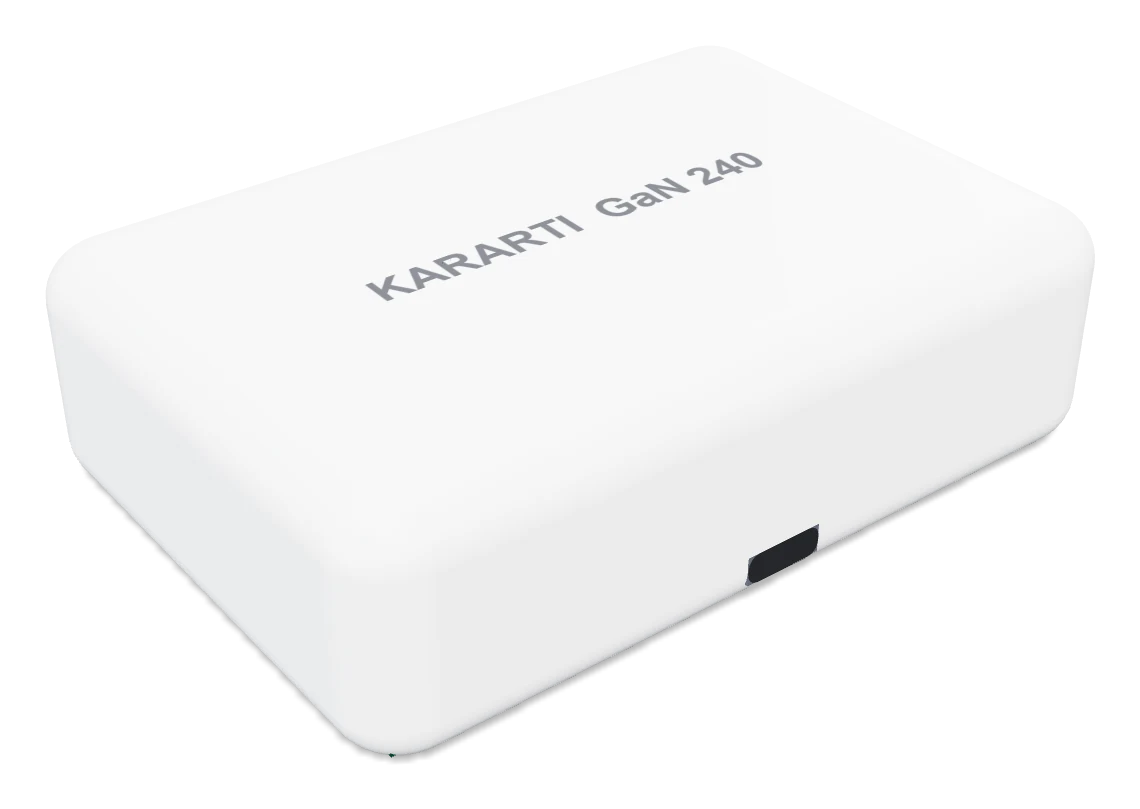
Small body · 240 W power
from bank card
a little big.
92 × 64 × 28 mm
only 9.2 cm long, 6.4 cm wide and 2.8 cm thick. The base of the GaN insert is only 6.4 mm longer and about 10 mm wider than a bank card.
Approximately 350g body; Approx. 400g with 240W USB-C cable. Dimensions refer to the current reference design.
Hybrid mode GaN
If there is a socket: brick
instead of palm
GaN (gallium nitride) transistors switch much faster and with less loss than silicon. Because they can operate at high frequency, transformers and coils become smaller: a charger delivering 240 W is reduced to 400 g. FRAGWATT uses these devices from USB-C1 at 28 V (140 W) or 48 V (240 W) with USB PD 3.1 EPR.
USB-IF certified PD 3.1 controller (TI TPS26750) on USB-C1 negotiates up to 48 V / 5 A with the GaN device; Protects the TPD4S480 port against 48V short circuit. A 5 A cable with e-marker is sufficient.
The charging stage (BQ25756) converts power to the battery bus. The 2-phase output meets the needs of the laptop directly from this power.
The battery covers the peak moments when GaN is not enough; As the load decreases, increasing power fills the cells. If the battery runs out, the laptop continues on GaN power.
| Installation | in the bag | LLM education (235 W) | AAA gaming (240W) |
|---|
Weights: FRAGWATT mass budget (Solo 620 g, KX-Link cable 95 g, tip 12 g) + manufacturer data: HyperJuice 140 W 256 g (+ ~50 g 240 W USB-C cable), Framework 240 W 400 g (with cables), ASUS ROG 330 W 800 g. Durations: firmware simulation, 3-hour test.
Working logic
Where is the power from?
where does it flow?
The firmware constantly recalculates the power that can be delivered to the laptop. The limit is the smallest of the tip class, selected profile, and available resources; The charger's power goes to the laptop first, and the rest goes to the cells.
Where does 0.946 come from? The power of the GaN charger is first converted to the battery bus (≈97%) in the BQ25756 charging stage, and then to the laptop (≈98%) in the two-phase LM5177 output stage. A 240 W GaN laptop carries ≈227 W; 140 W on a GaN ≈132 W.
What if the laptop wants 330 W? With 240 W GaN, the difference (~103 W) comes from the battery: the Solo covers this difference in hours, not minutes, because in AAA gaming the average is only slightly above 240 W. When the load drops, the increased power fills the cells.
What if the battery runs out? The laptop continues with GaN power: practically full power at 240 W, ≈132 W with the laptop's own power management at 140 W.
Contract
The TPS26750 (PD 3.1 with USB-IF certification) contracts 28 V (140 W) or 48 V (240 W) EPR with the GaN device. Protects the TPD4S480 port against 48V short circuit.
load first
The BQ25756 converts power to the battery bus; The output stage of the laptop meets its needs directly from this power.
Peak and remainder
When GaN is not enough, the battery comes into play; Excess fills the cells quickly within the range of 15–35 °C and slowly outside.
Which GaN?
charger
selection
FRAGWATT is brand independent: Any charger that supports USB PD 3.1 EPR will work. There are two things that are important: the device delivers EPR (28 V or 48 V) and a 240 W class USB-C cable with a 5 A e-marker.
| class | Voltage/current | net to laptop | sample weight | when |
|---|---|---|---|---|
| 100W (SPR) | 20V / 5A | ≈ 95W | ≈ 200g | Office, code, e-sports; Heavy duty battery also works |
| 140W (EPR) | 28V / 5A | ≈ 132W | 256g + ~50g cable | Light bag; GaN + battery together in gaming and LLM |
| 240W (EPR) | 48V / 5A | ≈ 227W | 400 g (with cables) | Desk all day: AAA and LLM 3 hours+ full power |
Sample weights from manufacturer data: HyperJuice 140 W (256 g), Framework 240 W (400 g with cables). Kararti is not affiliated with these manufacturers.
Our own design
Kararti GaN 240
FRAGWATT works with any USB PD 3.1 EPR charger; But we also designed the accompaniment. The Kararti GaN 240 delivers 240 W from 90–264 VAC to 5–48 V with a PFC + LLC power stage with three GaN switches and the same LM5177 in the output stage of the FRAGWATT. Schematics, component catalog and visible 3D model are on the engineering page.
Open schematic and 3D model →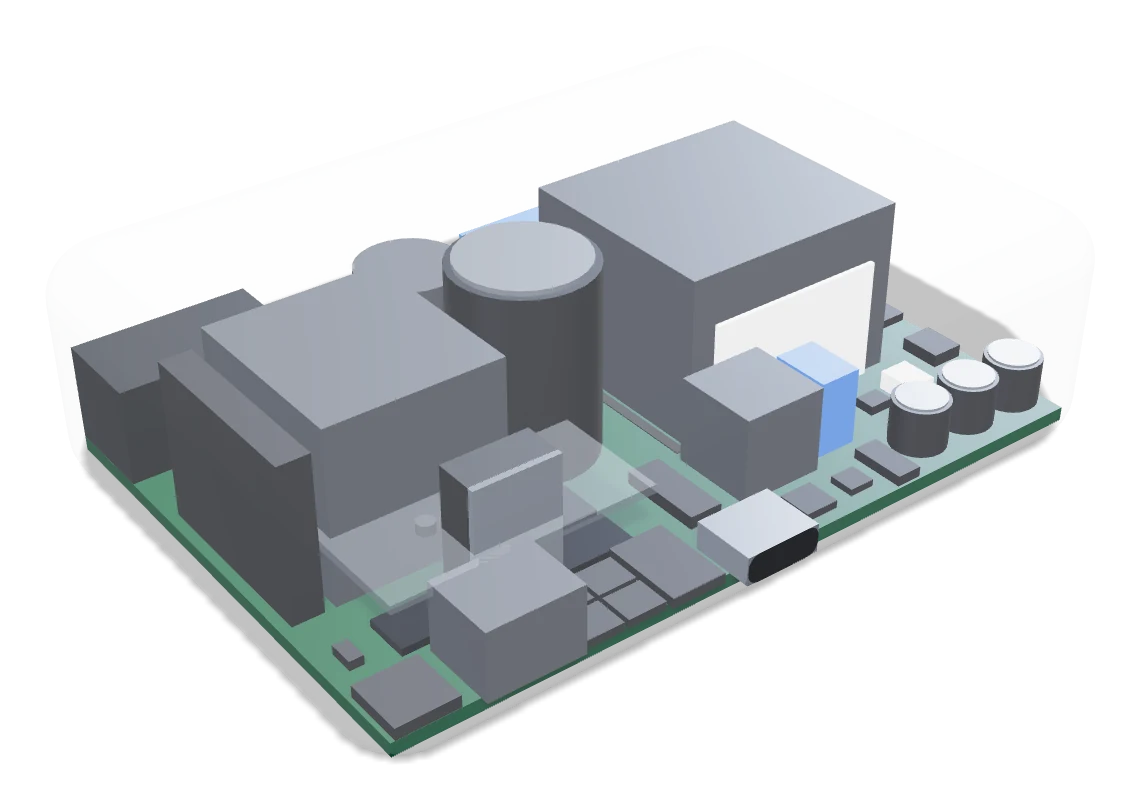
GaN PFC
UCC28056 + LMG3624 (700 V, driver and current sensing integrated): adapts mains current to sine wave, produces 390 V busbar; power factor ≈ 0.99.
GaN LLC + transformer
UCC256404 + 2 × LMG3624 half-bridge switches at zero voltage at ~200 kHz; 8:1:1 transformer steps down to 24 V with 5 kV isolation, UCC24624 rectifies synchronously.
USB-C EPR output
LM5177 converts 24 V to contract 5–48 V; Manages and protects TPS26750 (USB-IF certified) + TPD4S480 port.
| Login | 90–264 VAC, 47–63 Hz, IEC C8 (class II) |
|---|---|
| exit | USB-C PD 3.1 EPR 5/9/15/20/28/36/48 V + AVS 240 W |
| target yield | 93.6% (230 VAC, 240 W) |
| Measure/mass | 92 × 64 × 28 mm · ~350 g (~400 g with 240 W cable) |
| Piece | 124 components · 78 BOM lines |
The reference is in the design phase; EMI (EN 55032 class B), safety (IEC 62368-1) and efficiency measurements will be made on the prototype. The weight target is in line with the sitewide set calculation of "+240 W GaN ≈ 1.13 kg".